
From F*cked Up to Functional
How Plant-Powered Beverages are Drowning out Alcohol
Written By: SCOTT “SVH” VON HELDT
If you have ever been one to imbibe alcohol, then you have no doubt experienced many of the evils that lie therein. We’re talking blackouts, pounding hangovers, that creeping regret the morning after you’ve put back a twelve-pack or polished off a bottle of tequila. After all, they don’t call it spirits for nothing, as in some cases you become almost possessed by an entirely different version of yourself that is often followed by remorse. In fact, many believe the word alcohol itself was derived from a figure in Islamic lore known as Al-Kuhl, a seductive jinn-like spirit that would whisper urges to drink these toxic concoctions, serving as a cautionary figure for the moral struggles against intoxication.
Nevertheless, alcohol has been the king of social lubricants for centuries, but in 2025, that throne is beginning to crumble. Taking the lead in the new age of consumption are nootropics, adaptogens, hemp-derived THC seltzers, and functional tonics that promise a buzz without the brutal aftermath. These plant-powered drinks aren’t just a trend; they’re a full-on rebellion against the established order, and they’re drowning Big Alcohol one micro-dosed sip at a time.
Now, it’s stepping into the spotlight as a sophisticated new elixir, offering a prime alternative to alcohol.
THE CULTURAL SHIFT
Having spent years immersed in the cannabis industry, from its countercultural roots to its modern-day mainstream renaissance, I’ve watched this plant redefine its rituals time and again. Now, it’s stepping into the spotlight as a sophisticated new elixir, offering a prime alternative to alcohol. Gen Z and Millennials are leading the charge, trading hang- overs for clear-headed highs, and the data backs it up: nearly half of Americans are making a conscious effort to drink less alcohol in 2026, with younger folks driving the sober-curious movement. Daily or near-daily cannabis use is rising among young adults, inspiring many to put a new kind of liquid to their lips in the form of THC and functional beverages.
Younger consumers, especially Gen Z—with surveys showing up to 65% planning to cut back on booze—are drawn to the precision: low-dose THC for social vibes without fog, nootropics for focus amid daily stress. Women and high-income professionals are coming in strong too, seeking mood regulation and clarity over alcohol’s depressive effects. It’s “California sober” gone nationwide, urging the masses to ditch the booze and enjoy the benefits of plant medicines. Studies show cannabis can curb alcohol cravings, delay drinking desire, and reduce overall intake, resulting in less liver strain, better sleep, and controllable effects. Holiday sales reportedly have spiked too, with DoorDash reporting notable increases around 4/20. Bars are also experimenting with THC mocktails, while “Dry January” sees many extending their alcohol hiatus post-holidays, leading to a significant increase in cannabis and functional beverage sales.
Why the pivot? People still want the ritual—the clink of cans, the shared buzz, the deep unwind after a brutal day—just without the hangover. Nanoemulsified THC hits fast often (15– 45 minutes) with a more controllable high. Add nootropics or adaptogens, and these drinks leave you feeling better tomorrow, not wrecked.
Alcohol volumes are slipping while cannabis drinks surge: U.S. dispensary sales for cannabis beverages hit $54.6 million in Q1 2025 (up 15% year over year), with hemp-derived versions flooding mainstream shelves from Total Wine to convenience stores nationwide.
THE MARKET TSUNAMI CAUSING THE BOOZE BARONS TO SWEAT
Hard data backs up the hype, and big retailers are already betting big. Whole Foods pushes “FUNctional” bubblies with prebiotics and botanicals. Sprouts is rolling out innovation zones with dedicated functional-beverage end caps. Erewhon curates celebrity-backed stacks with in-store sampling for adult shoppers. Even Natural Grocers now stock hemp mocktails for “healthier habits without alcohol.” All of it lands against a backdrop of flat global alcohol volumes and shifting consumer tastes—while functional and cannabis drinks keep surging.
Cannabis beverages represented roughly $1–$1.7 billion in 2025, projected to reach $8–$24 billion by 2035, depending on legalization. The broader functional beverage market is already $150–$168 billion this year, on track for $220–$250 billion by 2030, with hemp-derived THC products driving much of the nationwide growth.
Then came December 18, 2025: the federal government announced it would reclassify cannabis from Schedule I to Schedule III—this could unlock new research opportunities, ease stigma, and accelerate mainstream adoption. While hemp rules have tightened in some states, the direction is clear—CBD and cannabinoids are fast becoming a new pillar of modern wellness.
SEEING IS BELIEVING: WATCHING THE SHIFT WITH MY OWN EYES
From 2023–2024, I got into the cannabis drink game, serving as VP of Sales for one of California’s largest manufacturers of cannabis-derived beverages. It was an eye-opening ride, gaining inside knowledge of the process and witnessing firsthand the explosive potential as new products launched and shelves filled. In speaking with longtime colleagues and innovators now shifting focus from regulated cannabis or alcohol to the functional beverage space, the future looks very bright as more brands move focus from high-volume profitability to high-quality wellness alternatives.
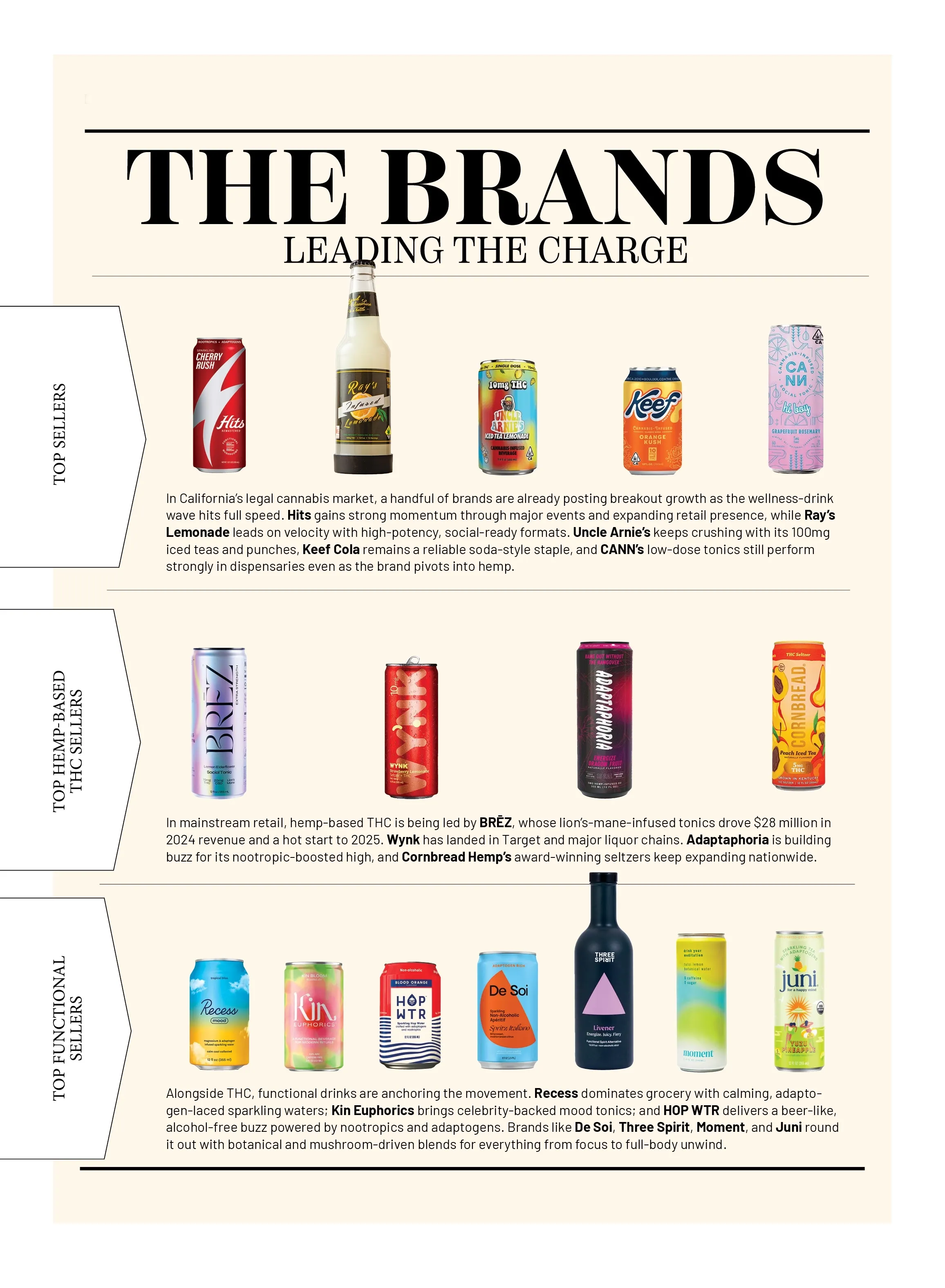
Take Michael Ramirez, co-owner of Hits Brands and founder of Mars Consulting, who’s partnering to push functional beverages into territories once reserved solely for alcohol brands. Hits is popping up backstage at major rock concerts, EDM festivals, nationwide sporting events, and even Hollywood red carpets. “We want to be a part of the normalization of alternative medicines, and that’s what we see happening by offering our brand to a wide range of artists and athletes,” Ramirez shares. With backgrounds from rock booking at Creative Artists Agency to pro surf culture and public service (Ramirez himself being a former Sacramento Fire Chief), the team prioritizes top-tier ingredients and standards in all their beverage lines. Hits uses green tea for 60mg of clean caffeine per serving, so no crash, perfect for all-day energy whether at a show or on the job. Ramirez adds, “The real reason we got into functional bever- ages was because my partners and I believe in natural ways of boosting the body and wanted to create a line of products that lift you up instead of lay you out like a lot of cannabis drinks do.”
Revolution Apothecary founder Justin Kleineider was drawn to the THC drink space by what he felt was missing. After more than two decades in fine wine, spirits, and champagne, he saw a space dominated by products designed to be mixed or built primarily around effect, often leaving the work to the consumer. Revolution Apothecary takes a different approach, creating multi-serve infused beverages meant to be enjoyed on their own, either on the rocks or straight up, with no mixing required, a philosophy the brand calls the Perfect Pour. Alongside that experience, the brand offers clarity and confidence through intuitive dosing, designed so one ounce equals one milligram. “We’re evolving the hemp beverage space by putting intention back into it,” Kleineider says.
Angie Stevenson—entrepreneur, actress and founder of Alohi— brings Hawaiian-inspired sparkle to the functional beverage space with adaptogens and botanicals for mindful elevation. “Alohi means ‘to shine or sparkle,’” she notes, reflected in a lineup of light, tropical flavors created to foster connection and balance. Alcohol giants like Pabst Blue Ribbon and St. Ides have made the pivot to offer cannabis and hemp-derived THC lines; nostalgia plays like Jones Soda have entered the market strong with Mary Jones, and legendary stoner duo Cheech & Chong bring High-Seltzers and the Cheechelada to a whole new legion of fans. All of this forward momentum proves that this is not just some passing fad, but a transformation of the drink space where functional is fast becoming the future of beverage.
CONSUMER TESTIMONIALS: REAL STORIES FROM THE FRONTLINES
As the plant-powered beverage revolution gains steam, it’s not just industry insiders and data points painting the picture—real consumers are sharing their journeys from alcohol dependency to functional freedom. Take Sarah, a 28-year-old marketing executive from Brooklyn, who swapped her nightly wine ritual for a low-dose THC seltzer infused with adaptogens. “I used to wake up foggy, anxious, and unproductive after even a couple of glasses,” she recounts. “Now, with something like a CANN tonic, I get that relaxed social buzz without the crash. It’s transformed my evenings into something restorative rather than destructive.”
Stories like Sarah’s are flooding social media platforms, where hashtags like #SoberCurious and #PlantPoweredLiving amass millions of views, showcasing before-and-after tales of improved mental clarity, better relationships, and enhanced overall well-being.
Then there’s Mike, a 35-year-old fitness trainer in Los Angeles, who discovered hemp-derived beverages during a Dry January challenge that stuck. “Alcohol was sabotaging my gains by dehydrating me, messing with my sleep, and leading to poor food choices,” he explains. “Switching to brands like BRĒZ with Lion’s Mane has kept me sharp for early morning sessions. No more hangovers means consistent performance, and I’ve even noticed better recovery times.”
These anecdotes highlight a broader trend: functional drinks are appealing to health-conscious individuals who view consumption as an extension of their wellness routines, much like choosing organic produce or hitting the gym. Online forums and review sites buzz with similar endorsements, where users praise the subtle euphoria and next-day vitality that alcohol simply can’t match. Parents and families are joining the chorus too.
Emily, a mother of two from Chicago, shares how adaptogen-packed elixirs like those from Kin Euphorics have become her go-to for unwinding after chaotic days. “With kids, I can’t afford the downtime from a hangover,” she says. “These drinks let me relax with friends or my partner without compromising my responsibilities. It’s empowering to feel in control.”
Such testimonials underscore the inclusivity of this shift, reaching beyond young urbanites to busy professionals, athletes, and families seeking balance in a fast-paced world. As more people vocalize their positive experiences, the stigma around alternatives to alcohol continues to fade, paving the way for even greater acceptance.
As more people vocalize their positive experiences, the stigma around alternatives to alcohol continues to fade...
WHAT HEALTH EXPERTS ARE SAYING
To lend further credibility to this growing movement, health professionals are weighing in on the science behind functional beverages. Dr. Elena Vasquez, a nutritionist specializing in integrative medicine, points out the biochemical advantages: “Alcohol is a neurotoxin that disrupts GABA and glutamate balance, leading to anxiety rebounds. In contrast, adaptogens like rhodiola modulate stress hormones without the rebound, while nootropics enhance cognitive function via BDNF pathways.” Her clinics have seen a 40% uptick in patients seeking alcohol alternatives, with many reporting reduced inflammation markers after switching.
Psychologist Dr. Raj Patel echoes this, noting the mental health perks. “The controllable effects of low-dose THC and CBD help users avoid the depressive cycles of alcohol,” he says. “Clients in therapy for substance use find these drinks aid in mindfulness and emotional regulation, fostering healthier coping mechanisms.” Studies from institutions like Johns Hopkins back this up, showing cannabis derivatives can assist in harm reduction for those with alcohol use disorders, potentially lowering relapse rates by 25% (read that again, 25% lower relapse rates)!
Even fitness experts like trainer Lisa Kwon advocate for these options in performance nutrition. “Incorporating THCV for appetite control or cordyceps for endurance gives athletes an edge without the caloric load or dehydration of beer,” she explains. As more research emerges, like ongoing trials on adaptogens’ role in longevity, the medical community is increasingly endorsing plant-powered drinks as viable, science-backed alternatives. This expert validation is accelerating the shift, turning skepticism into informed enthusiasm across all demographics.
SUSTAINABILITY AND ETHICAL SOURCING: THE GREEN SIDE OF THE BUZZ
Beyond the personal health benefits, plant-powered beverages are championing environmental and ethical causes that resonate deeply with eco-conscious consumers. Many brands prioritize sustainable farming practices for their ingredients, from organically grown hemp to wild-harvested adaptogens like ashwagandha and reishi mushrooms. Take Hits Beverage for instance, which sources its green tea and botanicals from fair-trade suppliers committed to biodiversity. “When we talk about the stuff in our drinks, we use all-natural ingredients, real juices, etc. We don’t use anything artificial and that’s extremely important, not just for our brand but for our customers, because we care what they are putting in their bodies,” notes Michael Ramirez.
This focus on sustainability extends to packaging like recyclable cans, minimal plastic, and even carbon-neutral shipping becoming the new standard. In contrast, the alcohol industry faces scrutiny for its envi- ronmental toll, including massive water consumption (up to 5 liters per liter of beer) and contributions to deforestation through cork harvesting or palm oil in some spirits.
Moreover, ethical sourcing ensures that communities benefit. Brands partnering with Indigenous growers for herbs like holy basil or schisandra support local economies and preserve traditional knowledge. This holistic approach appeals to Gen Z, who, according to surveys, are 2.5 times more likely to choose products with verifiable sustainability claims.
As regulations evolve, expect more certifications like USDA Organic or Fair Trade to dominate shelves, further distinguishing these drinks from the booze behemoths. In essence, sipping a plant-powered tonic isn’t just good for you, it’s good for the entire world by aligning personal indulgence with planetary health.
THE FUTURE IS FUNCTIONAL
By 2030, expect personalized cans for your every need like CBN for sleep, THCV for energy and appetite suppression, mushrooms for added clarity, and so much more. Think specialized tonics at bars, functional favorites stocked in coolers at your local gym, and maybe even handed to you post massage or chiropractic adjustment. As awareness grows, these redefine norms around entheogens and adaptogens, shifting our drinking experience from getting lit to being lifted. This evolution mirrors cannabis history and evolutions from being underground to essential. Plant-powered drinks offer better options for wellness-focused generations that are joining the revolution to shift from f*cked up to functional.
The Ingredients of a New Revolution: What’s in Your Can?
Let’s break down some of the magic in the mixture. Modern functional and cannabis beverages are stacked with plant power fine-tuned for the endocannabinoid system and brain chemistry, targeting internal wellness for good vibes and functionality.
1.
Start with nootropics, the cognitive enhancers:
Lion’s Mane mushroom: Neurogenesis and focus.
L-Theanine: Stacked with caffeine or THC for zen-like energy.
Alpha-GPC and Citicoline: Choline for mental horsepower.
Bacopa and Rhodiola: Memory and fatigue fighters.
2.
Then adaptogens, nature’s stress slayers:
Ashwagandha: Drops cortisol for calm relaxation.
Reishi and Cordyceps: Immune and stamina support.
Holy Basil and Schisandra: Mood elevators with a natural lift.
3.
And often hailed as the star of the show:
Hemp-derived Delta-9 THC for social euphoria. Add CBD/CBG for calm, THCV for energy/appetite control, or kava for relaxation. Zero calories, fast onset, organs intact, head clear.